
Beyond thoughtful design and choosing to work with natural fibres, we consider the impact of all of our business practices on our community and environment.
We exercise responsible purchasing practices, and through careful calculations, aim to only put into manufacture what we expect to sell, with a target that 10% of our garments end up on markdown.
We see the traditional sale model as a failure, which is why we created our Choose What You Pay Campaigns, turning an oversupply issue into an opportunity to fundraise for worthy causes.
Read more about Choose What You Pay, here.
At Assembly Label, we fundamentally reject the linear ‘take-make-dispose’ model that drives over-production and landfill waste. As a business practice, Assembly Label does not send any products to landfill. Through thoughtful product design, responsible inventory management and considered packaging, we work to minimise waste and maintain the highest standards of responsible business practice.

Our Carbon Footprint
At Assembly Label, we acknowledge our responsibility as part of the fashion industry to address global warming and climate change. In alignment with current government climate targets and the UN Fashion Industry Charter for Climate Action, we are committed to ambitious emissions reduction objectives and a robust decarbonisation strategy.
Read our Emissions Reduction Target & Decarbonisation Strategy Here
We are continuously working to reduce our carbon footprint and to manage our impact. At present, we are reducing our carbon emissions in the following ways:
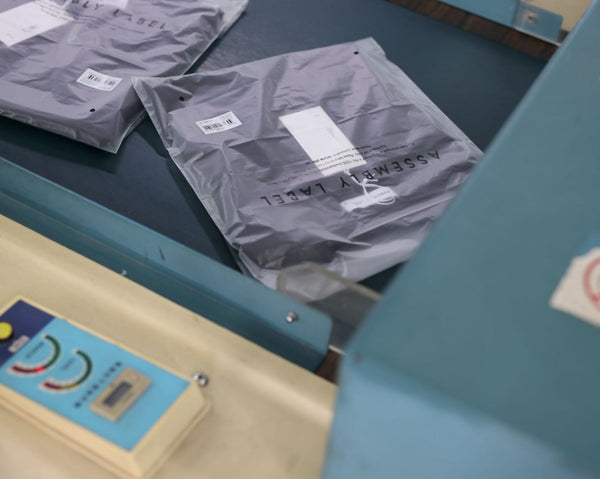
Labelling and Packaging
We are working towards a goal of using zero single-use plastic in our supply chain.
We currently use recycled alternatives made from ocean-bound plastic from The Better Packaging Co., and recyclable honeycomb kraft paper wrap.
The pallet wrap, tape and shipping labels we use are biodegradable and compostable, our boxes are recyclable and the pallets we use in our warehouses are recycled.

Energy Efficiency
We partner with Energy Locals, a carbon-neutral energy provider that provides credits to offset the energy usage of the business. Through Energy Locals, we purchase our energy through Cape Byron Power, operated by Cape Byron Management, consisting of two 30 MW biomass-fired power stations on the NSW North Coast. Together, these form one of the largest renewable baseload generators in Australia. The electricity is predominantly produced from sugarcane waste and certain types of wood residues and energy crops known as biomass fuel.
Freight
Shipping is an activity of the business in which we can make significant reductions, so we choose to work with freight partners who offer carbon-neutral delivery services.
We use the following postal services to send our orders:
Online
Australia Post - Carbon neutral parcel delivery - Australia Post (auspost.com.au)
New Zealand Post - Your parcel shouldn’t cost the earth | New Zealand Post (nzpost.co.nz)
B2B
DHL – Go Green climate neutral service where emissions are offset through climate protection projects. Offset Emissions | DHL | Australia
TNT/FedEx -Committed to becoming carbon neutral, we only use for B2B Sustainability and Carbon Neutrality | FedEx